
ZIP 33065
East Coral Springs
Near Mullins Park, eastern Coral Springs
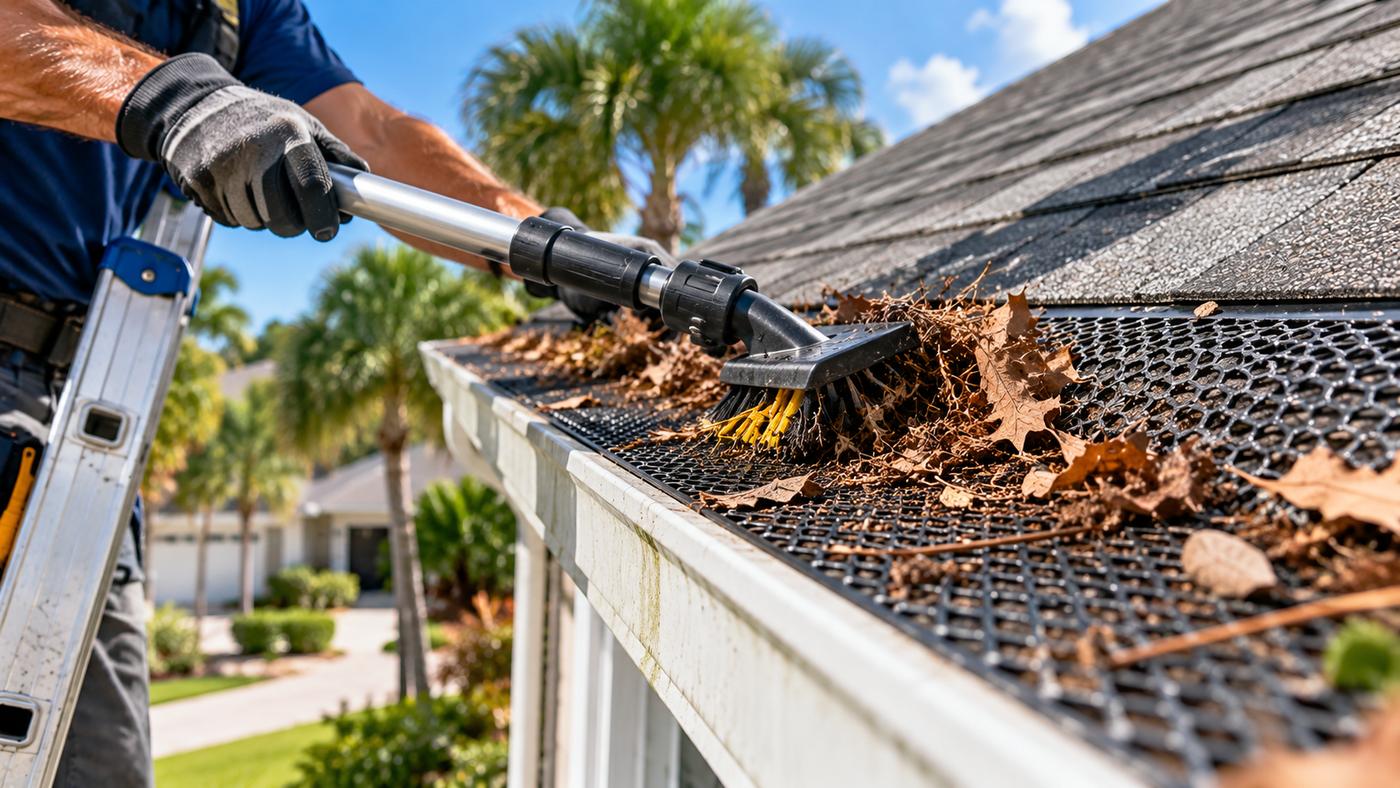
See ZIP 33065Gutter guard cleaning means cleaning the guard or screen on top of your gutter and clearing the trough underneath it. Guards stop leaves. Pollen, seed pods, and roof grit pile on top or slip through, so most guards still clog. Fast Pro cleans the guard, clears the trough, and flushes the downspouts.
ZIP codes we serve in Coral Springs
Serving Coral Springs, FL homeowners. 6+ years of experience. 450+ jobs completed. Last updated .

Every guard cleaning includes
Free inspectionGuards on Coral Springs homes still collect palm fiber and grit, with extra buildup near the city's lakes, canals, and parks. We handle the guard surface itself and dig out whatever's settled in the trough underneath.
Gutter guards across Coral Springs face fairly consistent conditions citywide, given how uniformly the city was developed after 1964, but proximity to water and green space still makes a difference. Homes near one of the planned lakes or canals, or close to the city's extensive park system, tend to collect more leaf litter and humidity-driven buildup on the guard surface than a lot set back from both.
Guard sections that release easily, without bending the frame, get lifted, brushed, and rinsed, and we clear the trough beneath them by hand. Because so much of Coral Springs' housing dates to a similar era, guard mounting tends to be fairly standard across the city, which makes this one of the more straightforward gutter guard jobs we do in South Florida.
The city's strict exterior standards mean some communities may specify a particular guard appearance, which we check before suggesting a replacement rather than a cleaning.
On the city's lake-adjacent streets, a guard that's otherwise in good shape can still need more frequent attention than one on a drier block, simply from the extra humidity speeding up buildup.
Yes. Guards change what lands in the trough and how often you have to deal with it. They do not end the job.
A guard works like a lid. It keeps big debris out, and water has to pass through or around it. Whatever the lid cannot pass stays on top, and whatever it lets through settles underneath. Pollen, seed pods, and roof grit are the usual culprits.
| Guard type | Blocks well | What gets through or piles up | How we clean it |
|---|---|---|---|
| Micro-mesh | Needles, seed pods, most roof grit | Wet pollen can film the surface and slow the water | Brushed and rinsed on top, trough flushed through the mesh or from the end |
| Screen or perforated | Large leaves | Needles, pollen, and grit pass through and settle underneath | Lifted where possible, cleaned, trough cleared by hand |
| Reverse-curve (surface tension) | Leaves and large debris | Fine debris can collect at the nose opening | Opening cleared and rinsed, trough checked and flushed |
| Foam inserts | Large debris, at first | Seeds sprout in the foam and debris embeds in the pores | Pulled and rinsed, or replaced if clogged through |
| Brush inserts | Large debris | Debris tangles in the bristles and holds water | Pulled out and shaken clean, trough cleared by hand |
We clean the guards that are already on your house. If you are weighing guards for a house that has none, tell us what falls on your roof first. The right guard depends on it. The gutter cleaning page lists what we pull out of an unguarded trough.
The steps change with the guard, so we start by finding out how yours is attached.
We look at the type, the material, and how it attaches. Some guards slide out, some hinge up, some are screwed down, and some tuck under the first row of roofing.
Sections that come up cleanly get lifted and set aside. We do not force a guard that is screwed or tucked, because bent frames leave gaps where debris gets in.
Surface debris comes off with a soft brush, and the guard is rinsed on both sides so the openings are clear.
This is where the pollen paste, seed pods, and roof grit have collected. We scoop it out and bag it, the same as on an unguarded gutter.
Water runs through each run and each downspout until the flow is steady. A guard does not stop a blockage at the elbow.
Each guard goes back flat against the roof edge and the gutter lip. A gap or a lifted corner lets debris in on the next storm.
You see the guard and the trough before and after, plus a plain note on any bent, cracked, or missing sections.
Pollen and fine debris sit on top of the guard, so we clean the surface before we reach the trough.
The same section of gutter, photographed from the same spot before and after.
Pick your ZIP code to see the neighborhoods we cover, or call and we will confirm your street.
East Coral Springs
Near Mullins Park, eastern Coral Springs
See ZIP 33065Central Coral Springs
Central Coral Springs
See ZIP 33071North Coral Springs
Northern Coral Springs
See ZIP 33076South Coral Springs
Southern Coral Springs, near the Sawgrass corridor
See ZIP 33067Not sure we cover your ZIP code? Call us at (813) 856-2726.
It depends on the roof size, material, and how close the home is to one of the city's lakes or canals. Give us your address and we'll price the work over the phone.
The price comes down to the feet of gutter, how many stories the home is, and how much buildup has accumulated. Give us a call with your address for a phone quote.
Early May is the visit to prioritize, since it lands right before the wet season starts. A second round between October and December, after hurricane season, handles the rest.
Yes. The extra humidity near the city's planned waterways can speed up algae growth and gutter streaking compared to a drier, more inland lot.
We cover the city end to end, across its roughly 24 square miles, from the areas near Mullins Park to the neighborhoods closest to the city's lakes and canals.
Routine cleaning doesn't change the exterior, so it generally isn't something the city's design standards apply to. Anything that changes how the roof or gutters look is a different matter.
Often, yes. The extra humidity near the water speeds up both gutter streaking and roof algae growth compared to drier inland streets.
Yes, the same as every other part of the city we cover. Give us your street and a nearby cross street and we'll take it from there.
Some communities set exterior standards that could apply to a visible guard style. We check before suggesting anything beyond cleaning.
At least once a year, more often near the city's lakes, canals, and parks where humidity and leaf litter run higher.
Generally, yes, more so than in an older city with a wider age spread, simply because so much of the housing here dates to a similar construction window.
Call and tell us what guard you have and what you see on top. We quote by phone and find a day that works.
Call (813) 856-2726